AI-Powered Global Search
Company
A leading SaaS provider
Year
2026
The enterprise accounting platform is a comprehensive financial management solution trusted by more than 37,000 nonprofits, associations, and government organizations. Finance professionals—including accountants, controllers, and finance directors—worked across a deeply modular system with no unified way to search across AP, AR, GL, payroll, and reporting.
Scope of Work
Problem Statement
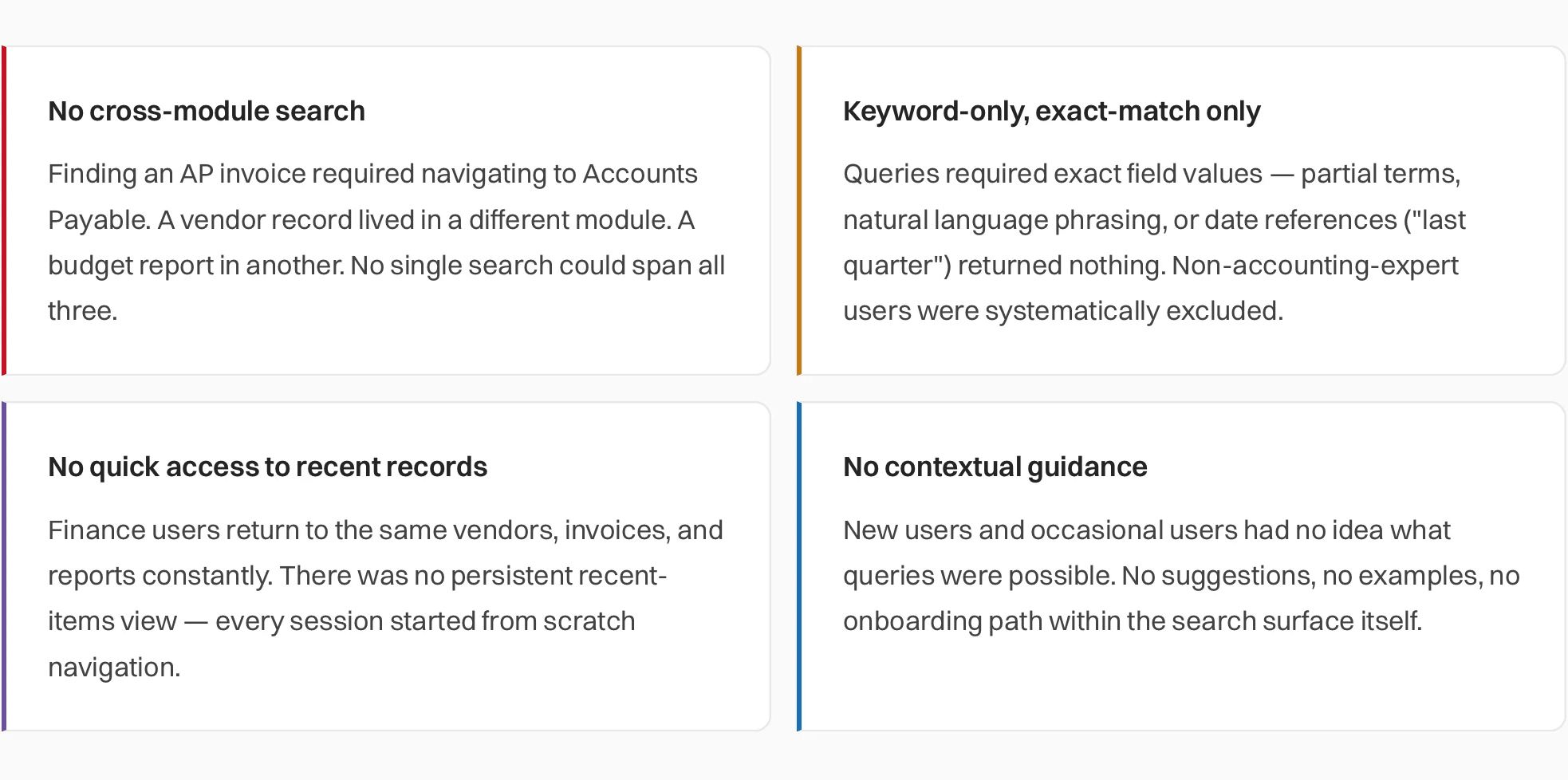
What was broken: The enterprise accounting platform is a deeply modular system — Accounts Payable, Accounts Receivable, General Ledger, Payroll, Budgeting, and Reporting each operate as their own workspace. Users had to know exactly which module held the data they needed, navigate there, and search within its local context. There was no platform-level search, no natural language input, and no way to jump to a record across modules.
Research & Discovery
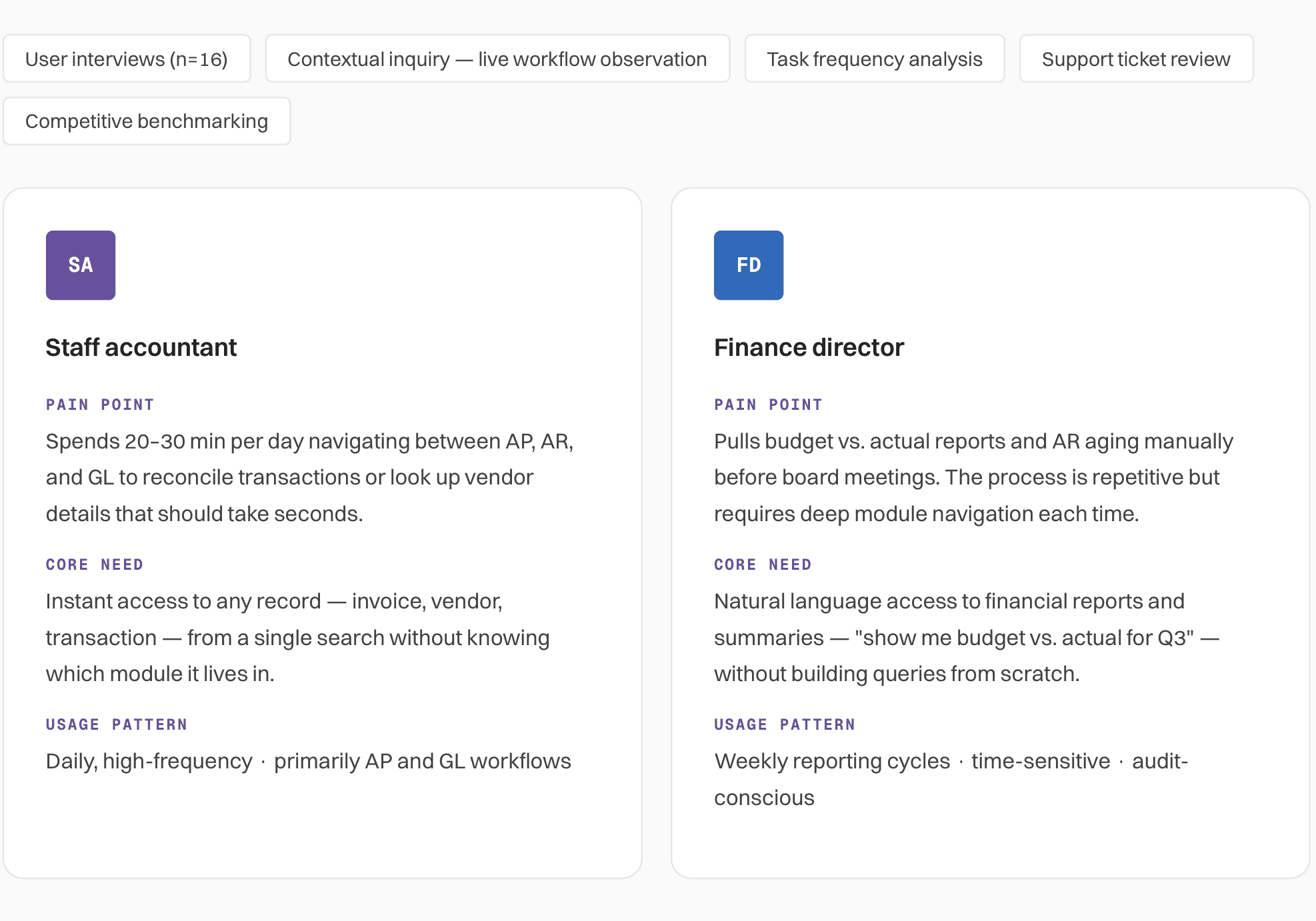
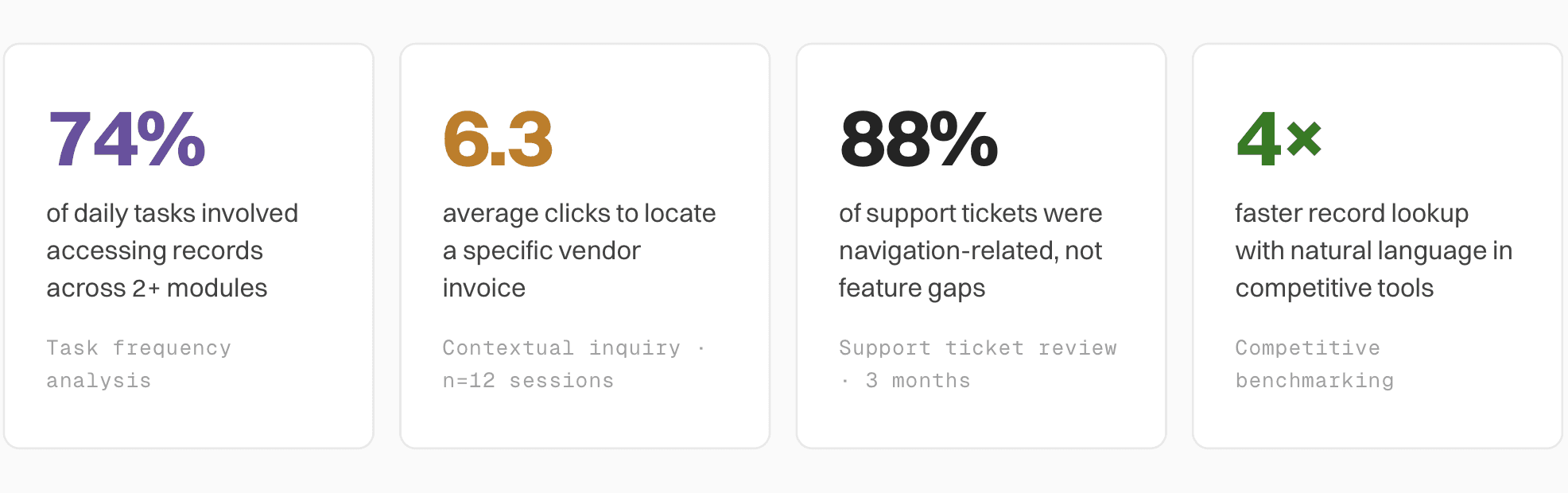
The platform serves finance professionals — staff accountants, controllers, and finance directors at nonprofits and associations. Their workflows are deadline-driven, audit-sensitive, and deeply repetitive. I ran interviews across three user tiers alongside contextual observation of real workflows.
Key research insights
How might we help enterprise accounting platform users instantly surface any record, report, vendor, or transaction using the language they already use — without needing to know which module holds the answer?
Define
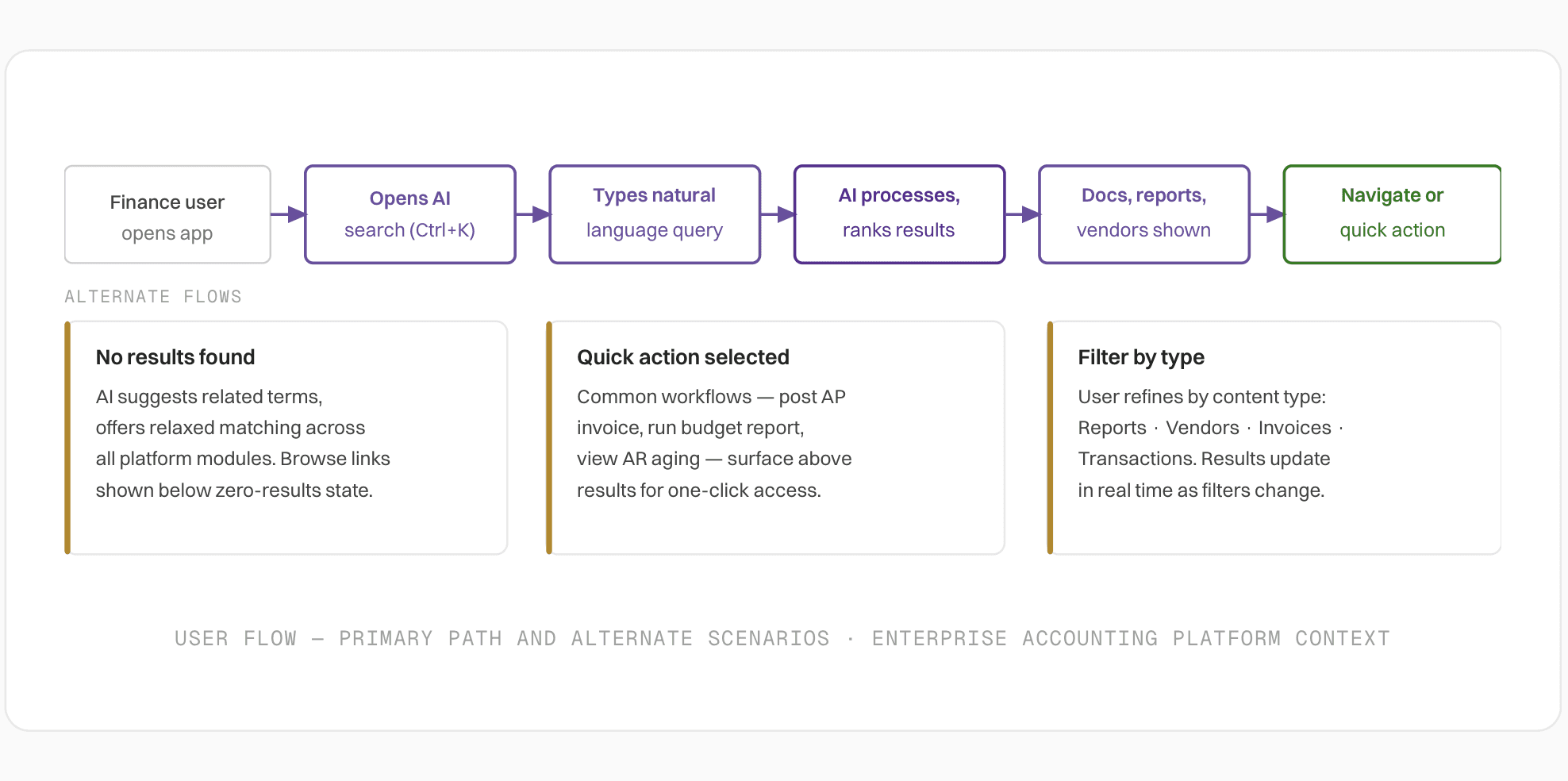
Mapping the search journey: I mapped the primary path — a finance user invoking global search via keyboard shortcut and navigating directly to a record — alongside three critical alternate scenarios specific to the platform's accounting context.
Design Process
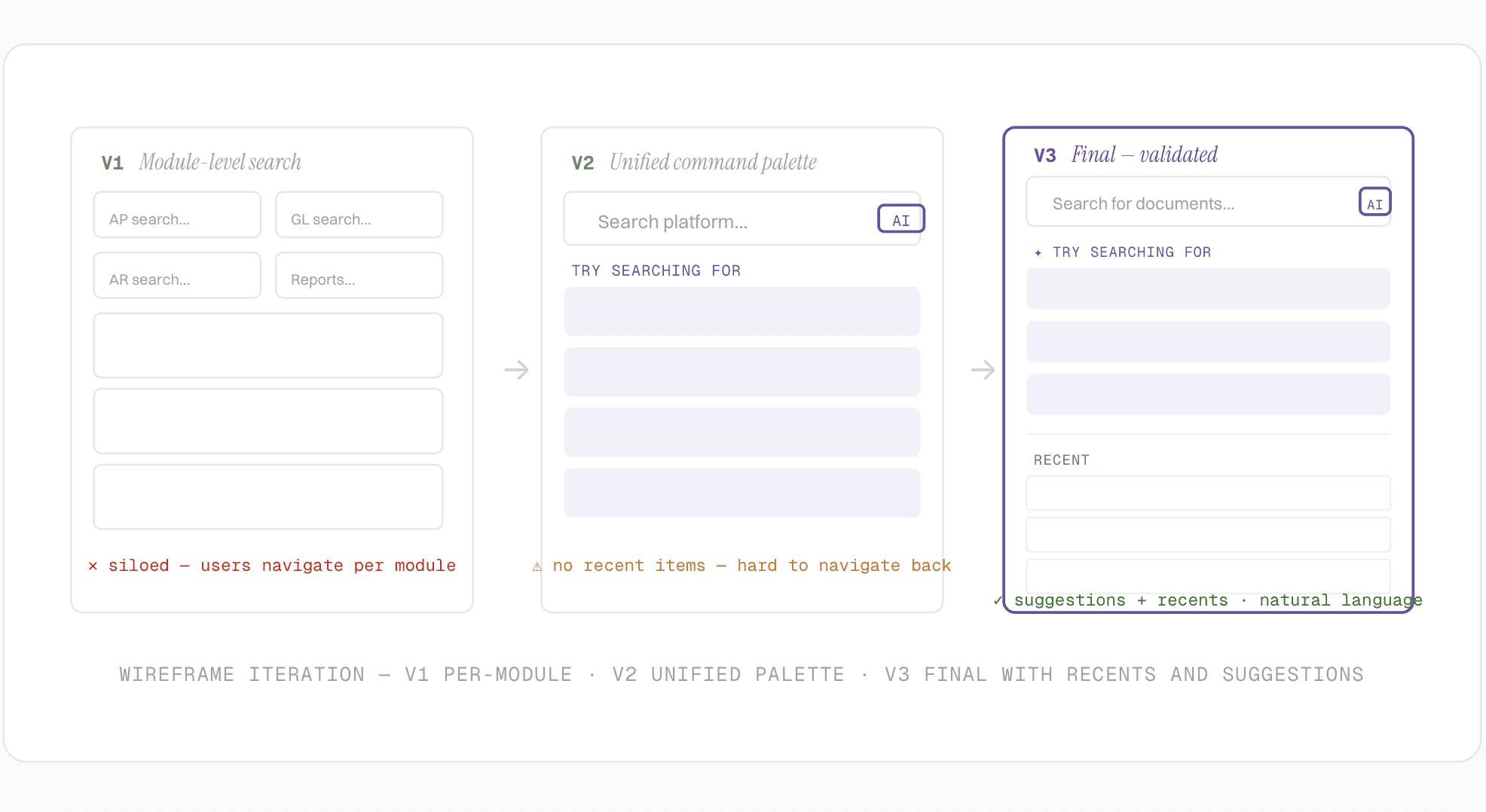
Three rounds of wireframes and testing: The platform context introduced a specific challenge: this was an accounting tool where precision and trust matter more than speed. Each iteration had to balance discoverability with the confidence that results were accurate and source-attributed.
v1: Module-level search
What was tested: Improved search bars within each module — AP, AR, GL, Payroll — with better keyword matching. No cross-module capability, no NL input.
Feedback: Users appreciated better matching within modules but the core pain — navigating to the right module first — was unchanged. "I still have to guess where to go."
v2: Unified command palette
What was tested: Global command palette (Ctrl+K) with NL input, AI chip, and contextual "Try searching for" suggestions. No recent items, no result-type filters.
Feedback: Significant improvement. But users who revisit the same records daily wanted quick access without typing. "I look up the same 5 vendors every day."
v3: Final — validated
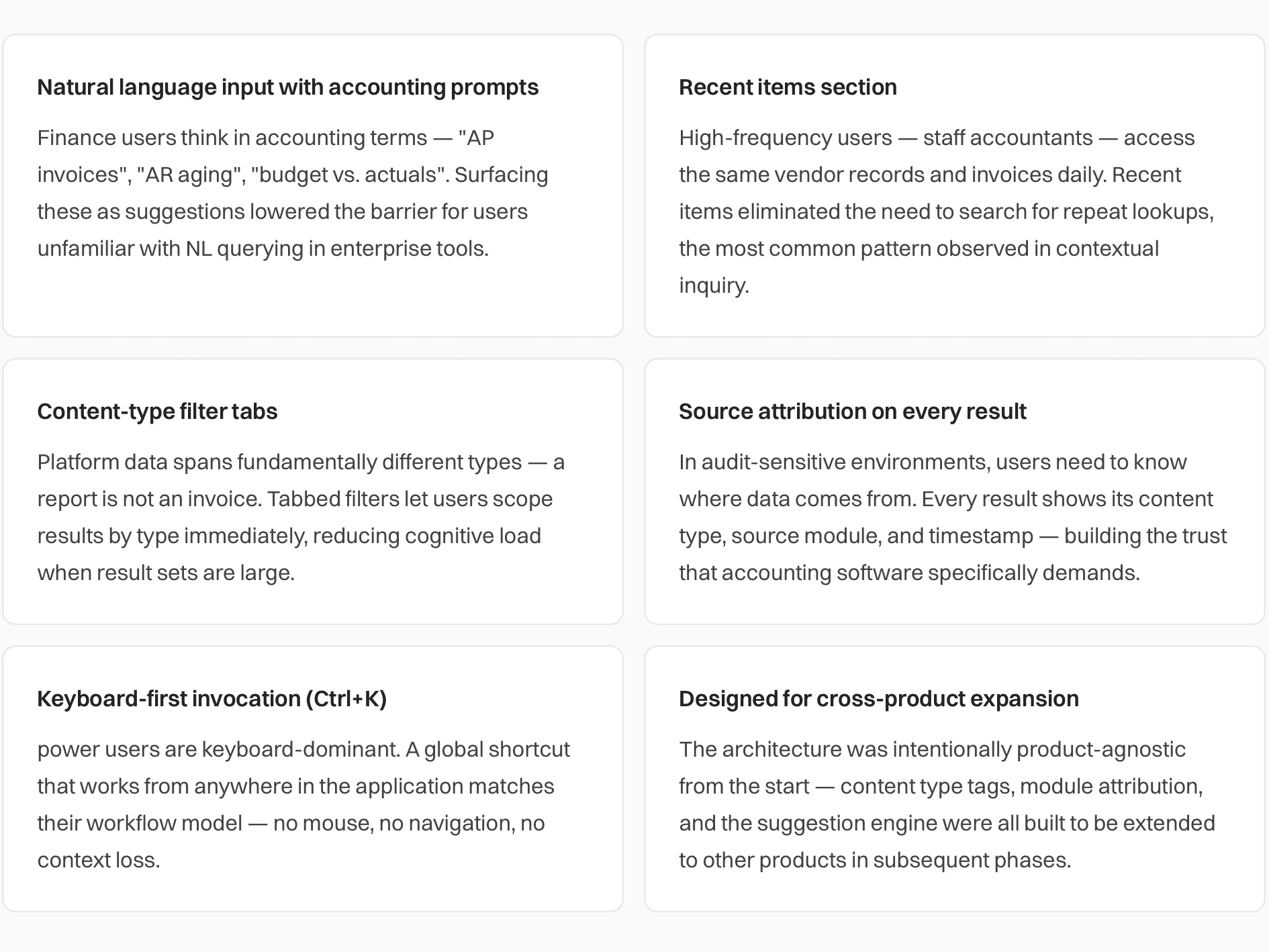
What was tested: Full palette: NL search with AI chip, contextual "Try searching for" prompts tailored to fund accounting (AP invoices, AR aging, budget vs. actuals), Recent items section, and content-type filters (Reports, Vendors, Invoices, Transactions).
Feedback: Task completion improved markedly. Power users navigated via Recent; new users followed the prompts. Finance directors used NL for report access without training.
Final Design
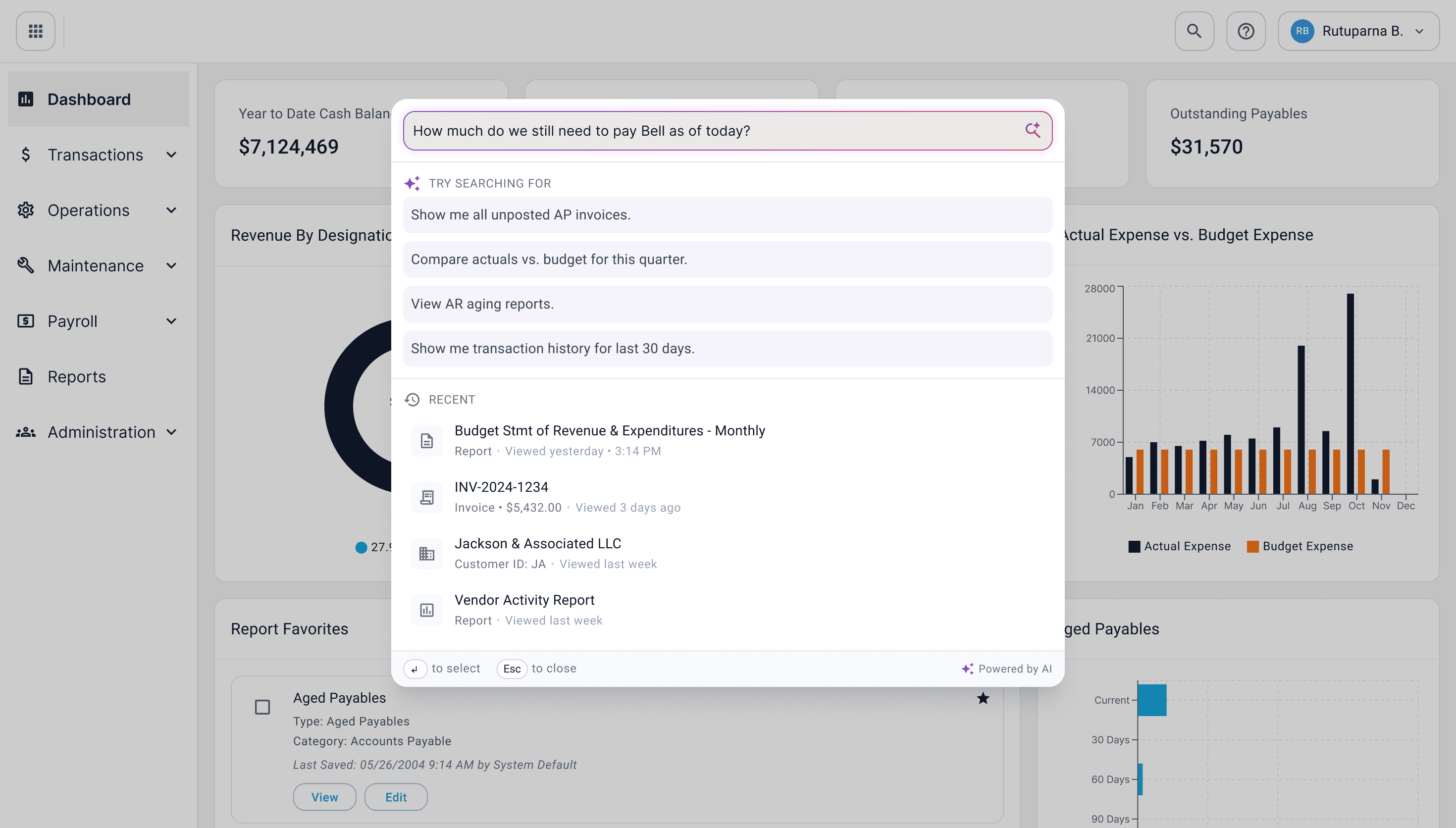
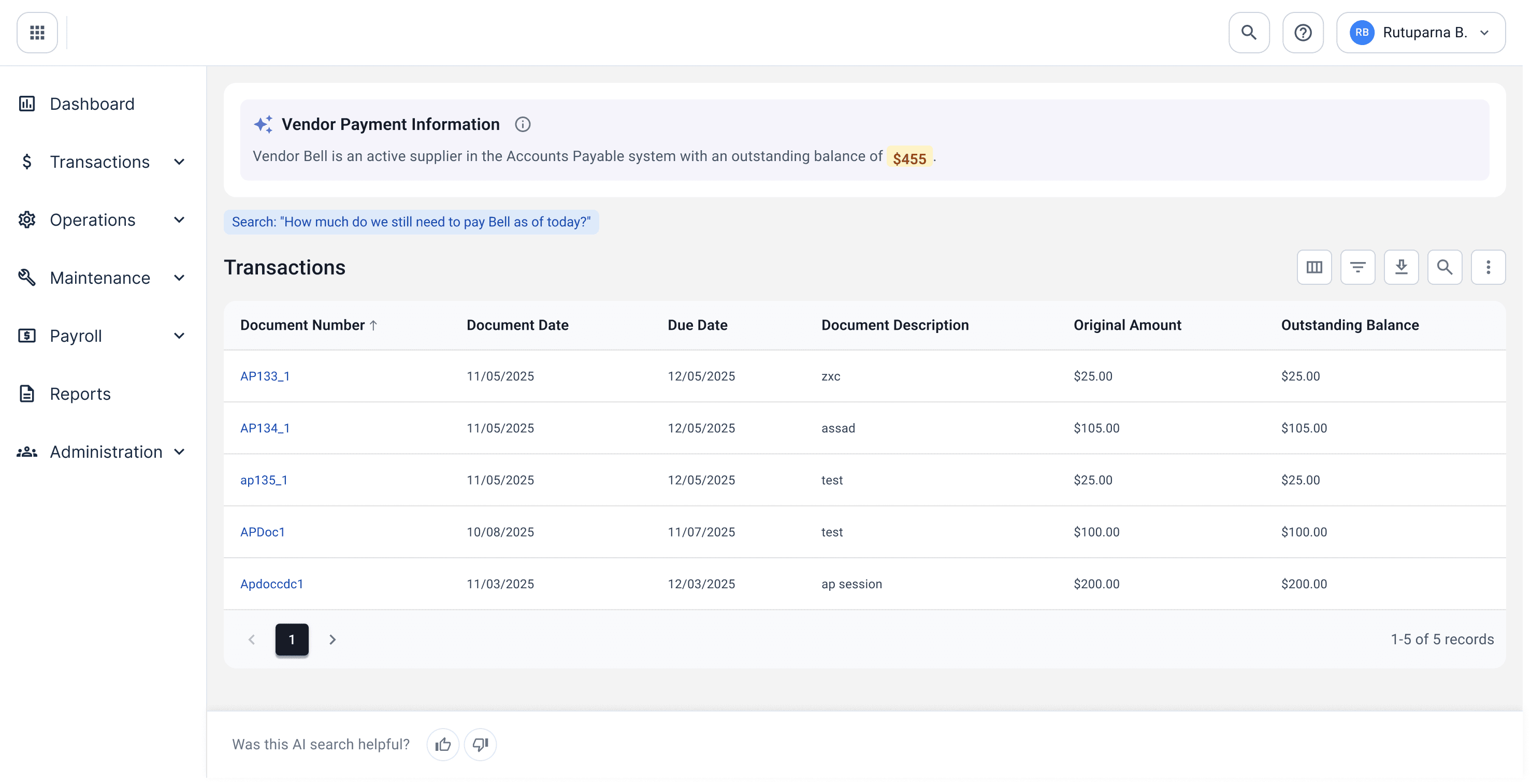
The shipped UI — results view: When a user types a query, results are returned cross-module and tagged by content type — Reports, Vendors, Invoices, Transactions — with module-specific accent colours for immediate orientation. The light-themed command palette (as shown in the reference) transitions to a results view that maintains the same structure.
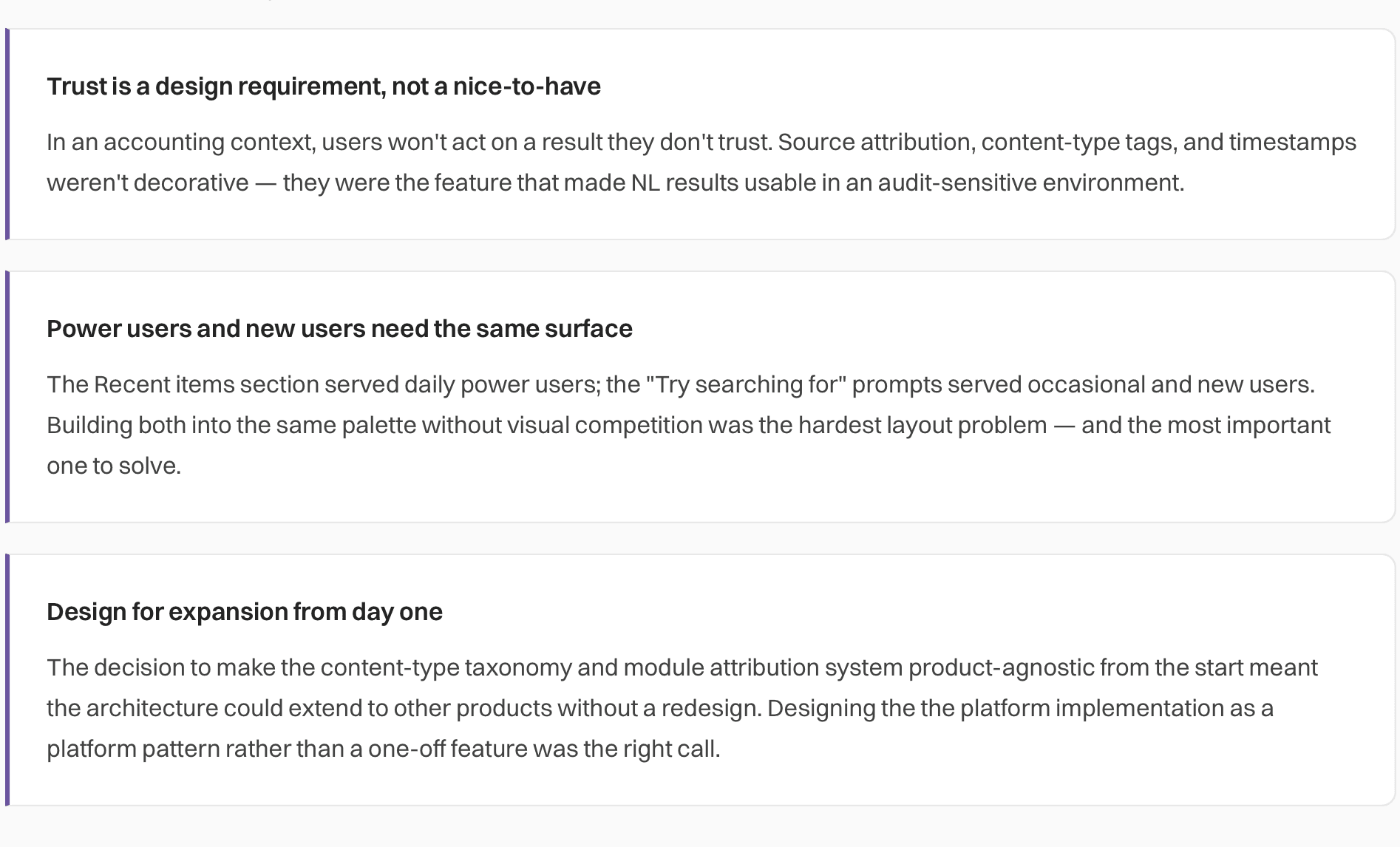
Design decisions and rationale
Outcome
The project resulted in a validated search experience and a scalable interaction model for bringing AI-powered discovery into a complex enterprise product. While the feature was not launched during my time on the project, the work established the foundation and direction for future implementation.
Validation
Usability testing helped validate the core search interaction, natural-language query patterns, and contextual suggestions. Feedback was used to refine the experience and establish a direction for future implementation.
Design outcomes
Finance stakeholders responded positively to using natural-language queries to access budget-vs.-actual reports, demonstrating the potential to reduce the manual report-building workflow ahead of board meetings.
Staff accountants found Recent Items valuable for quickly returning to frequently accessed vendors and invoices, reinforcing the importance of personalized retrieval.
The unified search experience addressed a clear navigation gap across the platform and established a more direct path to frequently used information.
AI Search became a key concept within the product roadmap, with the potential to serve as a marquee experience in future product and sales initiatives.
The underlying architecture and interaction model were designed with scalability in mind, creating a foundation for potential rollout across other products in the broader ecosystem.
What I'd carry forward